
Source code
Revision control


Copy as Markdown
Other Tools

Test Info:
- This WPT test may be referenced by the following Test IDs:
- /svg/shapes/scripted/ellipse-auto-radii.svg - WPT Dashboard Interop Dashboard


SVG Preview (Scaled)
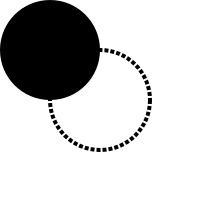
viewBox="0 0 200 200">
<title>SVG ellipse rx/ry auto resolution affects SVGGeometryElement methods</title>
<metadata>
<html:link rel="help" href="https://w3c.github.io/svgwg/svg2-draft/types.html#InterfaceSVGGeometryElement"/>
<html:meta name="assert" content="Per SVG 2 §10.4, an 'auto' value for either rx or ry on an ellipse resolves to the used value of the other property; if both are auto, both used values are 0. This resolution must apply uniformly to every SVGGeometryElement method (getTotalLength, getPointAtLength, isPointInFill, isPointInStroke)."/>
</metadata>
<html:script src="/resources/testharness.js"/>
<html:script src="/resources/testharnessreport.js"/>
<ellipse id="auto-rx" cx="50" cy="50" rx="auto" ry="50"/>
<ellipse id="auto-ry" cx="50" cy="50" rx="50" ry="auto"/>
<ellipse id="auto-both" cx="50" cy="50"/>
<ellipse id="explicit" cx="50" cy="50" rx="50" ry="50"/>
<ellipse id="stroke-auto-rx" cx="100" cy="100" rx="auto" ry="50"
stroke="black" stroke-width="4" stroke-dasharray="4 2" fill="none"/>
<ellipse id="stroke-auto-ry" cx="100" cy="100" rx="50" ry="auto"
stroke="black" stroke-width="4" stroke-dasharray="4 2" fill="none"/>
<ellipse id="stroke-explicit" cx="100" cy="100" rx="50" ry="50"
stroke="black" stroke-width="4" stroke-dasharray="4 2" fill="none"/>
<!--
Percentage cases. Inner <svg> establishes its own 200x100 viewport so
that a percentage on rx resolves against width=200 and a percentage on
ry resolves against height=100. With auto on the other axis, the used
value of the auto axis equals the resolved (axis-correct) pixel value
of the non-auto axis.
-->
<svg id="pct-viewport" x="0" y="200" width="200" height="100">
<ellipse id="pct-auto-rx-50ry" cx="100" cy="50" rx="auto" ry="50%"/>
<ellipse id="pct-50rx-auto-ry" cx="100" cy="50" rx="50%" ry="auto"/>
<ellipse id="pct-auto-rx-25ry" cx="100" cy="50" rx="auto" ry="25%"/>
</svg>
<script><![CDATA[
'use strict';
test(function() {
const expected = document.getElementById('explicit').getTotalLength();
assert_approx_equals(document.getElementById('auto-rx').getTotalLength(),
expected, 0.5,
'auto rx should resolve to ry');
assert_approx_equals(document.getElementById('auto-ry').getTotalLength(),
expected, 0.5,
'auto ry should resolve to rx');
}, document.title + ', getTotalLength resolves auto rx/ry.');
test(function() {
assert_equals(document.getElementById('auto-both').getTotalLength(), 0,
'both auto means rendering disabled');
}, document.title + ', getTotalLength returns 0 when both rx and ry are auto.');
test(function() {
const expectedPoint = { x: 100, y: 50 };
const explicitPt = document.getElementById('explicit').getPointAtLength(0);
assert_approx_equals(explicitPt.x, expectedPoint.x, 0.5, 'explicit x');
assert_approx_equals(explicitPt.y, expectedPoint.y, 0.5, 'explicit y');
const autoRxPt = document.getElementById('auto-rx').getPointAtLength(0);
assert_approx_equals(autoRxPt.x, expectedPoint.x, 0.5, 'auto-rx x');
assert_approx_equals(autoRxPt.y, expectedPoint.y, 0.5, 'auto-rx y');
const autoRyPt = document.getElementById('auto-ry').getPointAtLength(0);
assert_approx_equals(autoRyPt.x, expectedPoint.x, 0.5, 'auto-ry x');
assert_approx_equals(autoRyPt.y, expectedPoint.y, 0.5, 'auto-ry y');
}, document.title + ', getPointAtLength(0) at the 3 o\'clock starting point.');
test(function() {
const center = { x: 50, y: 50 };
const outside = { x: 200, y: 50 };
['auto-rx', 'auto-ry', 'explicit'].forEach(function(id) {
const el = document.getElementById(id);
assert_true(el.isPointInFill(center),
id + ': center is in fill');
assert_false(el.isPointInFill(outside),
id + ': point outside the resolved ellipse is not in fill');
});
}, document.title + ', isPointInFill resolves auto rx/ry.');
test(function() {
const onBoundary = { x: 150, y: 100 };
assert_true(document.getElementById('stroke-explicit')
.isPointInStroke(onBoundary),
'explicit: point on boundary is in stroke');
assert_true(document.getElementById('stroke-auto-rx')
.isPointInStroke(onBoundary),
'auto-rx: point on boundary is in stroke (auto rx resolves to ry=50)');
assert_true(document.getElementById('stroke-auto-ry')
.isPointInStroke(onBoundary),
'auto-ry: point on boundary is in stroke (auto ry resolves to rx=50)');
}, document.title + ', isPointInStroke with dasharray resolves auto rx/ry.');
// Inner <svg> viewport is 200x100. Percentages must resolve against the
// non-auto axis (a 50% on ry resolves against height=100, not width=200);
// the auto axis then takes that resolved pixel value.
test(function() {
// rx=auto, ry=50% in 200x100 -> ry = 50, rx = 50, perimeter = 2*pi*50.
assert_approx_equals(document.getElementById('pct-auto-rx-50ry').getTotalLength(),
2 * Math.PI * 50, 1.0,
'auto rx with ry=50% must resolve via height axis (50), not width axis (100)');
// rx=50%, ry=auto in 200x100 -> rx = 100, ry = 100, perimeter = 2*pi*100.
assert_approx_equals(document.getElementById('pct-50rx-auto-ry').getTotalLength(),
2 * Math.PI * 100, 1.0,
'auto ry with rx=50% must resolve via width axis (100), not height axis (50)');
// rx=auto, ry=25% in 200x100 -> ry = 25, rx = 25, perimeter = 2*pi*25.
assert_approx_equals(document.getElementById('pct-auto-rx-25ry').getTotalLength(),
2 * Math.PI * 25, 0.5,
'auto rx with ry=25% must resolve via height axis (25)');
}, document.title + ', getTotalLength resolves auto rx/ry against percentage values on the correct axis.');
test(function() {
// Path begins at the 3 o'clock point: (cx + rx, cy).
// For rx=auto, ry=50% in 200x100: (100 + 50, 50) = (150, 50).
const p = document.getElementById('pct-auto-rx-50ry').getPointAtLength(0);
assert_approx_equals(p.x, 150, 0.5, 'auto-rx + ry=50% starting point x');
assert_approx_equals(p.y, 50, 0.5, 'auto-rx + ry=50% starting point y');
}, document.title + ', getPointAtLength(0) with percentage ry uses height-axis resolution.');
]]></script>
</svg>